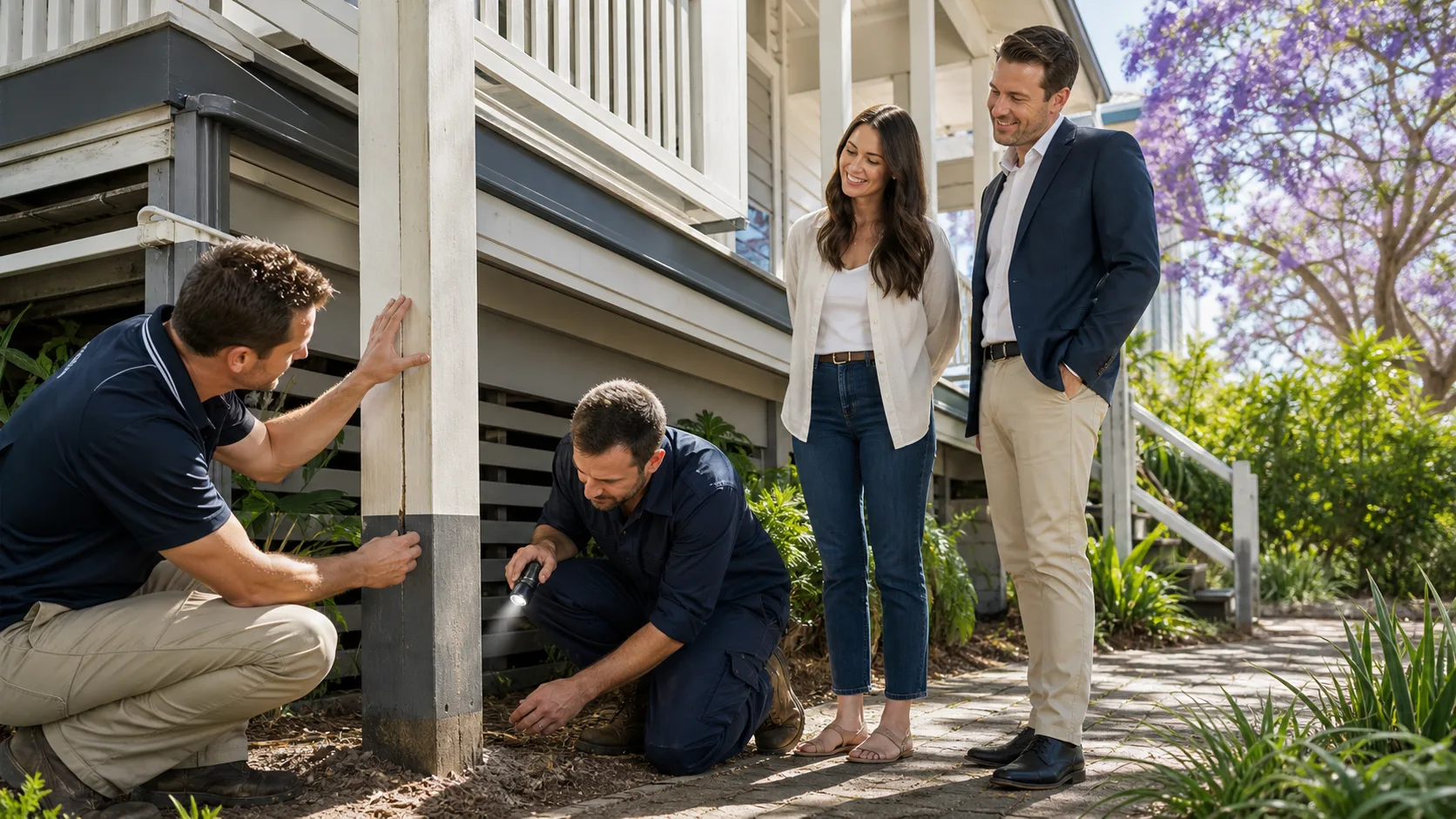
October in Brisbane means two things for inner-city agents: storm campaigns and more termite activity. When you are lining up auctions and private treaty deals before Christmas, a vague building and pest report can be the difference between a clean contract and a nervous buyer walking away. Clear reporting around building defects vs pest damage is what keeps price discussions grounded in facts, not fear.
In this guide I’m writing from my own inspection work in inner Brisbane, the jobs your buyers send me to in Paddington, New Farm, Woolloongabba and the CBD fringe. I’ll walk through how I, as an inspector, think about structural issues compared with active termites, how those findings usually flow through to value, what actually happens on inspection day, and which timelines and disclosure steps keep your deals moving.
The goal is simple: move from “problem” to “plan” quickly, so you can protect your sale price and your relationship with both seller and buyer.
How Clear Reporting Protects Your Sale Price
Inner Brisbane buyers are sharper than ever. They turn up with comparison reports, pest treatment questions and building-savvy friends. If their report just says “issues noted” or “possible termites” without detail, they often assume the worst.
From my side of the clipboard, clear, separated findings help you to:
- Explain what is structural and what is not
- Distinguish old damage from active termite activity
- Attach rough timeframes and steps to each problem
- Keep negotiations focused on costed risks instead of open-ended fear
When everyone understands the difference between building defects vs pest damage, you can negotiate on real risk, not rumours. That’s where your price protection comes from.
Exactly What Happens on Inspection Day
Agents often tell me their biggest stress point is coordination: access, timing, and knowing when they’ll have something concrete to tell their buyer and seller. Here’s how I typically run an inner Brisbane combined building and timber pest inspection, step by step, so you know what to expect and can keep momentum.
- Booking and confirmation
- Your buyer (or you on their behalf) books a time. For auction campaigns I recommend locking a few preferred windows early, as October fills fast.
- I confirm scope: building under AS 4349.1 and timber pest under AS 4349.3, plus any specific concerns you or the buyer flag (e.g. known termite history, suspected movement).
- You receive a confirmation email with date, time window, estimated onsite duration, and when to expect the report (usually same day or within 24 hours for standard properties).
- Pre-inspection coordination
- You arrange access with the occupier and ensure keys/FOBs/garage remotes are available.
- I’ll ask you to confirm: roof access, subfloor access for older Queenslanders, access to garages, store rooms and exclusive-use courtyards in units.
- On arrival
- I check in with you or the occupier, outline where I’ll start and roughly how long I’ll be.
- If you’re onsite, I’ll quickly confirm any known issues or previous repairs so I can factor that context into the report.
- Building inspection sequence (AS 4349.1)
In a typical character home in Paddington, Red Hill or Ashgrove:
- External: roofs, gutters, downpipes, decks/verandahs, external walls, retaining walls visible from the site.
- Subfloor (where accessible): stumps, bearers, joists, drainage issues.
- Internal: walls, ceilings, floors, doors/windows, wet areas.
- Roof space: framing, insulation, signs of leaks.
In inner-city apartments:
- Unit interior, balconies, doors/windows, wet areas.
- Readily accessible parts of common property when reasonable and where access is provided, while respecting body corporate limitations.
- Timber pest inspection sequence (AS 4349.3)
- I look for evidence of termites, borers and fungal decay.
- I use a moisture meter and a sounding tool to check skirtings, frames and other accessible timbers.
- I record active termite activity, historic damage, and conditions conducive to attack, such as garden beds over slab edges or damp subfloors.
- Onsite verbal summary
If you’re onsite or available by phone, I give you a plain-language summary before I leave:
- Key structural defects I’ve seen
- Any evidence of active termites vs old damage
- Items that I consider urgent vs items that are maintenance
This is not a substitute for the written report, but it lets you manage expectations and keep the conversation moving same-day.
- Report delivery and debrief
- The written report, with photos, risk ratings and next steps, is usually sent same day (or within 24 hours for larger/complex sites).
- I’m available for a three-way call with you and the buyer to walk through findings. This is often where we convert anxiety into a plan and keep your deal intact.
Reading Between the Lines of a Building and Pest Report
My reports follow AS 4349.1 for building and AS 4349.3 for timber pests. These Standards set out the minimum scope and reporting format for pre-purchase inspections in Australia. I work to or above those benchmarks so you can tell clients, confidently, that the inspection sits within recognised Australian Standards.
The structure is always similar so you can scan quickly:
- Summary with risk ratings
- Photos tied to each finding
- Plain-language notes on likely cause and next step
- Clear identification of any inaccessible areas, as required by the Standards
I clearly separate and label:
- Structural defects
- Non-structural building defects
- Timber pest damage
- Conditions conducive to termite attack
Under AS 4349.1, “major defect” usually means something that affects structural performance or safety, like significant movement, decayed structural timber or serious water entry. “Minor defect” covers smaller items, such as cracked tiles or sticky doors.
Your role with nervous buyers is to translate: major does not always mean catastrophic; it means “needs a plan and budget”. That’s where a joint conversation between you, the buyer and me is powerful.
Structural Defects Vs Active Termites in Inner Brisbane
Understanding the difference between structural building defects and timber pest damage is essential before a buyer commits. The two issues behave differently, are costed differently and are viewed differently by lenders and insurers.
Under AS 4349.1, a structural defect is a problem that affects the load-bearing parts of the building. In our inner suburbs that might be:
- Sagging verandahs on character Queenslanders in Paddington and Red Hill
- Undersized or decayed bearers in old high-set homes around Highgate Hill
- Foundation movement leading to stepped cracking in brickwork
- Rusting steel framing or balustrades in older riverfront units
Under AS 4349.3, active timber pest activity means live termites or fresh workings. Historic termite damage is where timber has been attacked in the past but no live activity is found, for example:
- Old mud trails in an Ashgrove subfloor
- Soft framing around a damp garage in New Farm that has already been treated
- Garden beds built up over slab edges in Teneriffe units that create a risk, even if no activity is yet found
- Previous bait stations around a Norman Park cottage with no current activity
Why the difference matters before buying:
- Most structural defects are predictable building problems that can be scoped and managed. Engineers and builders in Brisbane see them every day.
- Active termites are a biological risk; they move, they spread and they make lenders and insurers nervous.
- Historic termite damage, where treatment has been done and no live activity is present, usually sits somewhere in between and can often be dealt with by documented repair and monitoring.
This is why I keep the lines clear when I talk about building defects vs pest damage and document the difference carefully in the report.
Valuation Impacts, Timelines and Negotiation Tactics
From what I see across inner Brisbane campaigns, valuers and buyers tend to respond in fairly consistent ways.
When a report finds structural defects, they often include:
- Restumping allowances in older workers cottages in Woolloongabba
- Roof repair or replacement allowances in post-war homes in Clayfield
- Concrete cancer repair programs in older inner-city units
- Balcony and balustrade remediation in 70s, 80s walk-up blocks.
These items can often be priced with builder quotes, then you negotiate from there.
Active termite activity is different. Even when repair work is modest, the fear factor is higher. You may see:
- Lenders asking for updated pest clearance or evidence of treatment
- Buyers insisting on fresh treatments before settlement
- Conditional offers, longer contract clauses and more conservative valuations
A working rule of thumb I use when talking to agents:
- Structural building defects: expect negotiations around quotes and timing; often suited to price adjustments, settlement extensions or agreed pre-settlement works.
- Active pest activity: expect a bigger “what if” discount and tighter conditions until the infestation is treated, repaired and documented.
Repair timelines also shape your strategy. In inner Brisbane I commonly see:
- Restumping and structural timber repairs needing multiple visits and engineer input.
- Roof repairs and balcony remediation stretching out, especially as storms approach.
- Brick cracking and fire stair upgrades in older units needing body corporate coordination.
On the termite side:
- Full treatments need booking, chemical application and then confirmation of no further activity.
- Damaged framing must be opened up and repaired.
- Buyers often want written treatment records they can keep and give to future buyers.
October can be a squeeze. Storms highlight roof leaks, termites swarm more often and trades start filling their calendars. This is where you decide with your vendor: fix before listing, disclose and discount, or negotiate post-settlement works.
Choosing Inspection Types and Managing Anxiety
Agents often ask whether they really need both building and pest. My honest view, based on what I see day to day:
- A standalone building inspection can be enough for many modern concrete inner-city apartments where structure is clear and there is an active, well-documented body corporate record.
- A full timber pest inspection is non-negotiable for high-set Queenslanders, older weatherboards, dense gardens in places like Bardon or Norman Park, or any home with past termite treatment history.
- A combined building and pest inspection is usually best for pre-auction and private treaty campaigns, so you can talk through building defects vs pest damage in one conversation and avoid conflicting opinions from different providers.
When a concerning report lands, buyer reactions are often emotional first, logical second. The calm path I use with agents is:
- Pause, don’t rush to slash price or panic the vendor.
- Clarify the findings directly with me (or the inspector): was that a structural crack or a cosmetic one, active termites or historic damage?
- Get proper quotes or treatment plans from a builder or pest controller.
- Map options with your vendor: price adjustment, conditions (e.g. works before settlement), or disclosure and walking away from that buyer.
- Reframe the issue to the buyer in terms of cost, time and risk, not headlines.
A three-way call between buyer, agent and inspector often clears up misunderstandings, especially around what the Australian Standards actually require and what is simply part of older Brisbane housing.
What to Do When Serious Findings Appear
Here is how I suggest agents respond to different levels of findings.
- Major structural defect, no termites (e.g. significant restumping needed in a Red Hill Queenslander)
- Step 1: Obtain at least one builder quote and, where needed, engineer advice.
- Step 2: Discuss with your vendor: fix now, negotiate price, or sell as-is with full disclosure.
- Step 3: For auctions, consider pre-listing repairs or at least a quoted repair figure available in the data room.
- Step 4: For private treaty, adjust expectation ranges and build the repair into buyer conversations early.
- Historic termite damage, no active termites (e.g. old mud trails in Ashgrove)
- Step 1: Confirm treatment history and supporting paperwork.
- Step 2: Arrange an updated pest inspection and, if needed, a booster treatment or monitoring plan.
- Step 3: If framing is affected, obtain repair quotes and have those available.
- Step 4: Present this to buyers as an issue that was addressed and is now managed, backed by documents.
- Active termite activity (e.g. live termites in a Norman Park subfloor)
- Step 1: Immediate pest manager call-out for treatment, not just monitoring.
- Step 2: Once activity is controlled, open up and repair damaged timber with a builder; document everything.
- Step 3: Expect tougher negotiations. Structure your vendor conversation around the combined cost of treatment + repair + perceived risk.
- Step 4: Consider delaying auction or renegotiating contract timeframes to allow treatment and follow-up checks.
In each case, my role is to clearly document the condition and explain, in plain language, what type of risk we are dealing with so you can choose the right strategy.
Disclosure, Expectations and Safer Deals
Good disclosure protects everyone. Agents and vendors should keep a simple checklist:
- Known active termites and any current treatments.
- Structural repairs, including invoices and warranties.
- Previous termite damage and what was done about it.
- Any engineering reports or body corporate special levy notices tied to building defects.
My reports clearly state inspection dates, scope under AS 4349.1 and AS 4349.3, and any areas I could not access. That way you can safely share the document or extracts and explain its limits.
It also helps to set expectations early. A building and pest inspection under AS 4349.1 and AS 4349.3 is a point-in-time, visual, non-invasive look, not a guarantee that nothing will ever go wrong. When you explain that upfront at open homes and in contract chats, you reduce later claims that buyers “did not know”.
How I Communicate with You as the Agent
Because you’re managing the relationship on both sides, my focus is on predictable, transparent communication:
- Clear booking windows so you can plan opens and access.
- Onsite check-in and verbal summary where possible.
- Written report within the agreed timeframe, usually same day.
- Availability for follow-up calls with you, your buyer and, where sensible, the vendor.
- Consistent terminology aligned with AS 4349.1 and AS 4349.3 so you can speak confidently to risk.
This reduces surprises and helps you keep campaigns on track, even when issues arise.
Guarantees, in Plain Terms
I’m often asked what my reports “guarantee”. Within the framework of AS 4349.1 and AS 4349.3, here’s the plain-English version of what I offer:
- The inspection is conducted with due care and skill, in line with the relevant Australian Standards.
- The report reflects what was reasonably observable on the day, without damaging the property or moving heavy furniture or stored items.
- If you or your client are unclear on a finding, I will clarify it at no additional cost.
- If a genuine error is identified in the report (for example, a clear misclassification of a defect), I will correct the report and work with you to explain the correction to all parties.
What I cannot honestly guarantee:
- I cannot guarantee future performance of the building or that termites will never appear after the inspection.
- I cannot see through walls, sealed linings or floor coverings.
Setting this out clearly helps you as an agent avoid over-promising to buyers while still using the report as a solid risk-management tool.
Why This Matters for You as a Referral Partner
For inner Brisbane agents, your reputation sits partly on the professionals you recommend. When you refer an inspector, you are really asking three questions:
- Will this person give my buyer a realistic, standards-based view, not a scare campaign?
- Will they distinguish clearly between building defects and timber pest issues so negotiations stay rational?
- Will they communicate in a way that keeps my campaign moving instead of stalling it?
My whole approach, from report format, to on-the-day process, to follow-up calls, is built around those questions. If you know how I work, you can confidently say to your buyers and vendors: “Here is what will happen, here is what the report will and won’t cover, and here is what we’ll do with the findings.”
In the end, the agents who handle building defects vs pest damage well tend to have fewer blown-up contracts. They separate structural from biological risk, attach clear plans to each, and keep everyone talking about timelines and evidence instead of worst-case stories.
If you align your processes with that approach, you protect both your sale price and your long-term relationships in the inner Brisbane market.
Protect Your Brisbane Property With Expert Inspection Today
If you are unsure whether you are dealing with building defects vs pest damage, we can help you get clear answers before small problems turn into costly repairs. At Paul Klumper from Building & Pest Bne, we provide thorough, practical inspections and straightforward guidance tailored to your property. Reach out to our team to book an inspection or ask a question about your specific situation, or simply contact us to get started.